
Belleville Previous Residents by Era
A Belleville address has no single, unbroken occupant list. Modern parcel and deed records establish ownership clues; directories and open census schedules supply household evidence; maps and permits date physical changes. Begin with the year closest to the question, then move backward one verified link at a time.
| Source | Years covered | Where held | What it can show |
|---|---|---|---|
| Assessor cards | Sample links reach 1999 | St. Clair County DEVNET | Year-specific owner, site, mailing, parcel, legal description |
| Recorder images | Most January 1986 forward | Recorder, Tapestry, Laredo | Deed parties, recording date, instrument and legal text |
| Digital directories | 1921 to 1972, selected years | Belleville digital archive | People, firms, institutions, locations |
| Library directories | Selected years, 1860 to 1935 | Public Library Archives | Dated names, addresses, firms and street listings |
| Historical Society | Directories 1868 to 2010; atlases 1874 to 1956 | History Discovery Center | Long address runs and map context |
| Federal census | Open schedules through 1950 | NARA and library databases | Households in an enumeration area |
Use the newest deed and assessor route for a recent owner. Use a directory year nearest the target date for previous residents. For the nineteenth century, expect repository research, handwritten indexes, and gaps rather than one online search.
Date Belleville Address History First
Write down the year before searching a name. A 1926 directory entry, a 1930 newspaper notice, a 1936 directory entry, and a 1956 atlas describe four different moments. Merging them into one household erases moves, address changes, and the difference between a person and a property.
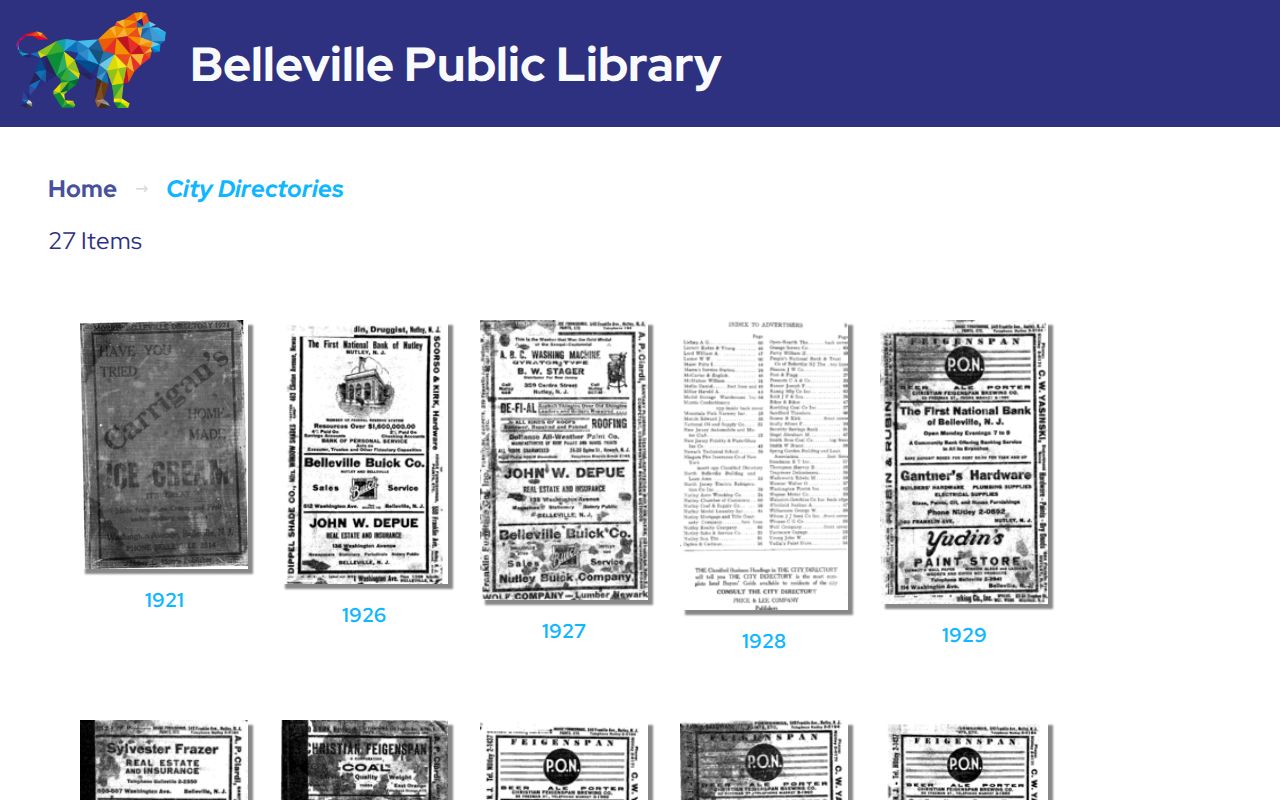
The official digital index contains 27 directory items: 1921, 1926 through selected later years, and a final 1972 volume. The Public Library also links earlier editions beginning in 1860. A missing year does not prove the household moved. It may only mean no edition survives online or the name was printed under a different form.
Trace St. Clair Deeds Backward
The title trail starts with today's parcel, not an assumed former resident. Pull the parcel number and legal description from the St. Clair County Assessor. Then search the current owner in the Recorder's free index. A deed chain identifies title parties. Occupancy requires a second source.
- Save the current parcel number, legal description, owner, site address, mailing address, and tax year.
- Search the current owner's full name in Recorder AVA over a reasonable date range.
- Open or order the purchase instrument and confirm that its legal description matches the parcel.
- Take the seller, or grantor, and search that person as an earlier buyer, or grantee.
- Repeat while recording instrument number, date, role, description, parcel reference, and image status.
Trusts, estates, companies, survivorship, quitclaim deeds, tax deeds, and parcel splits can break a simple chain. Stop calling a party a resident when the role is lender, trustee, attorney, lien claimant, or mailing contact. For records before the remote-image run, use office workstations, copy requests, older deed books, the Historical Society, or IRAD.
- Grantor and grantee
- The grantor transfers an interest; the grantee receives it.
- Chain of title
- The linked sequence of instruments that traces ownership interests.
- Legal description
- The land description used in deeds, often more stable than a street address.
- Instrument number
- The Recorder's unique key for one recorded document.
Belleville Deed Access Beyond AVA
AVA is free, but it provides index data rather than document images. It enables party, date range, document type, document number, and parcel searches. Address and book/page controls were disabled in the inspected settings. That is why the parcel number from the assessor is so useful.
The Recorder's remote-access page lists Tapestry as pay-as-you-go image access and Laredo as a subscription service. Seven public workstations permit free searching in the office. Staff can help with index use. Fewer than ten non-certified pages may be requested by email or phone; certified copies and requests of ten pages or more go by mail with payment. The public series reaches the late 1790s, though the office describes most online images as January 1986 forward.
Note: An AVA result is an index lead; the instrument image or certified copy is the source for the deed's full language.
Pair Belleville Directories and Census
Directories fill the years between open federal census schedules. Start with a dated address entry, then locate the closest census year. Census pages can show a household, ages, relationships, birthplace, and other fields for that enumeration. The directory can then move the address forward or backward to the next available edition.
- Record the directory year, page, printed name, street number, and all abbreviations.
- Find the street in the closest open census and identify its enumeration district.
- Compare names and ages, but do not merge similar people without another matching fact.
- Check the next directory edition to see whether the household, surname, or address changed.
- Add a deed, obituary, or vital index only with its own date and source label.
The full publishers, volumes, and reading methods belong to the Belleville city directory page. For house history, the crucial act is preserving what each edition says about this address.
Belleville Directory Years Online
The authorized Belleville archive offers directories, newspapers, photos, and yearbooks. Its directory index spans selected editions from 1921 through 1972. Search the volume closest to the target year and record the page image because no dependable named OCR sample was recovered during research.
The Belleville city-directory index displays the editions available for browsing.
The library's newspaper collections extend the timeline: the Semi-Weekly Advocate covers 1840 to 1915, the Daily Advocate 1898 to 1958, and the News-Democrat collection begins in 1901. HeritageHub supplies obituary and death-notice searching from 1824 to today.
Map Old Belleville Addresses
The Library of Congress 1884 Sanborn set contains 14 Belleville sheets. It can show a block, street, building outline, and historic land use. The Historical Society adds atlases dated 1874, 1901, 1936, and 1956. None identifies every occupant, so pair the map with a directory or deed.
West Belleville was platted in the 1830s and incorporated into the city in 1882. Later district labels include Old Belleville, Hexenbuckel, and Oakland. Such changes explain why an old volume may use a community label that a modern GIS search does not. No official citywide street-renaming or number-conversion table was found. Preserve the printed address and ask the library, City Clerk, or GIS staff about one block.
Belleville Record Gaps Have Causes
St. Clair County was established in 1790, and its early record history is not seamless. The State Archives inventory reports that an old courthouse was partly destroyed by fire. Illinois law permits certified copies to be re-recorded after public records are destroyed. An unusual transcript, reconstructed index, or later recording should therefore be labeled, not treated as the original.
IRAD's St. Clair County holdings include land, court, naturalization, marriage, death, probate, and local-government series. The local-government catalog has assessor books from 1826 to 1861 and other early records. Contact the IRAD repository when the Recorder's current tools stop, and give staff the names, place, date range, and record type already known.
A blank search is not proof that no previous residents existed. Log the source's dates, missing volumes, spelling tried, and whether the search covered an index or image.
Belleville Past Households and Obituaries
Owners are only one layer of who lived here before. Directories may name a householder or concern, and census schedules may show a full household. Newspapers and obituaries can connect relatives and dates. The Walnut Hill burial index can confirm a burial date and location, while original sexton books contain additional fields that changed over time.
Keep each fact in its lane. A funeral ledger is not a death certificate. A burial entry is not an obituary. A probate file may name heirs, an executor, property, and addresses, but access can depend on age or sealing. Modern probate is routed through the Circuit Clerk; older material also appears at IRAD and the Historical Society.
Lawful use. Research previous residents for house history, genealogy, estates, and personal curiosity. Never use names or addresses to stalk, harass, threaten, or track a living person.